

They were the mop-topped lads from Liverpool who changed music forever.
They sparked Beatlemania, toppled charts, and nearly drowned in their own screaming fans.
They experimented with LSD, meditation, and moustaches.
They played stadiums before anyone knew how to amplify them, broke up in public, and still managed to soundtrack half a century of weddings, protests, and road trips.
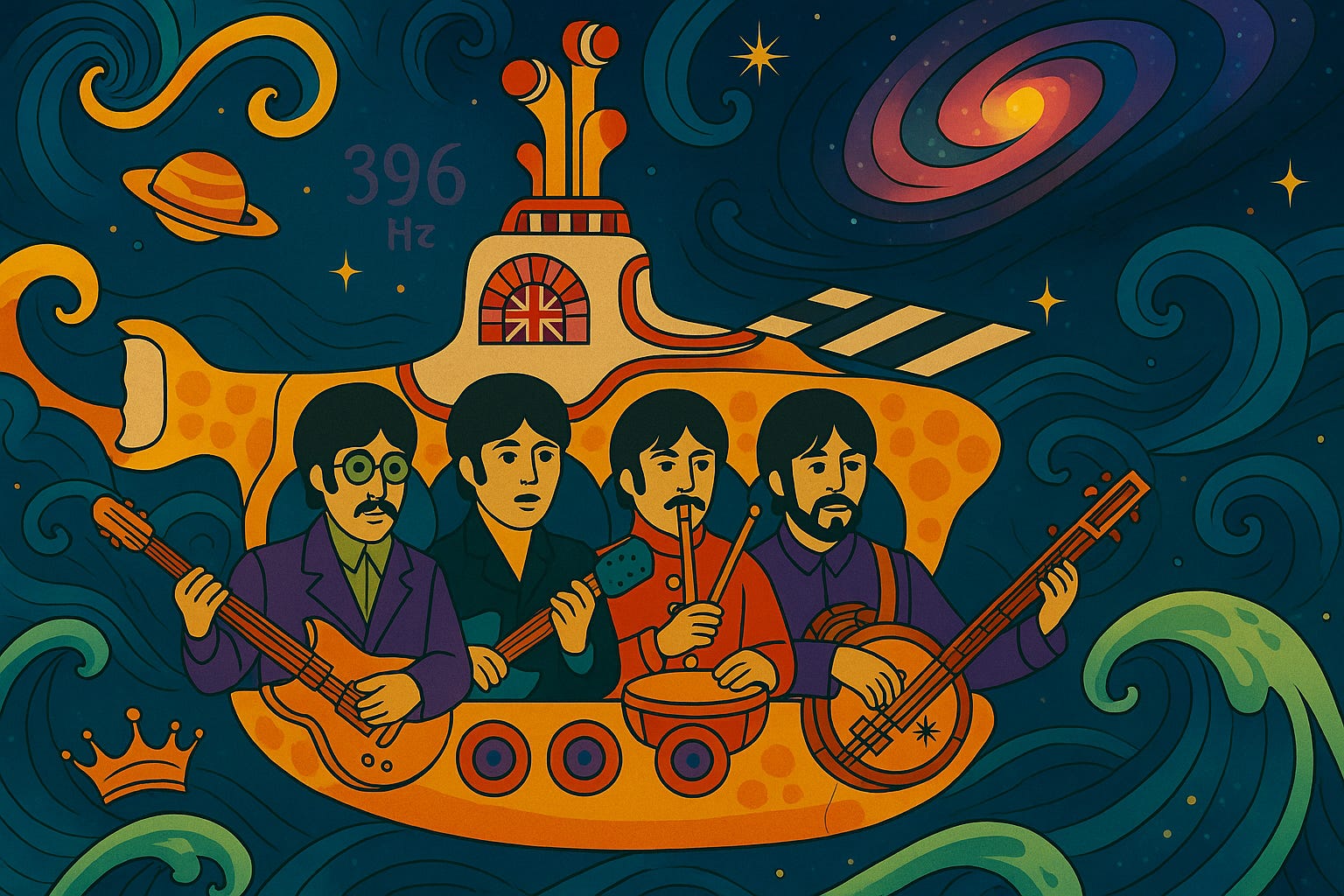
The Beatles are revolution and raw pop genius - all crammed into one psychedelic yellow submarine.
But what if beneath the mania, the mop tops coded something deeper into their sound?
What if one of their gentlest ballads wasn’t just a lullaby for grief?
What if it is the very frequency for letting go?
Could their music actually be medicine for your nervous system?
Normally I’d say grab a coffee and keep scrolling, but that does not feel appropriate for British Beatle territory. So grab a tea, a scone, and in the words of George Harrison: here comes the sun.
A Hard Day’s Night (of Beatlemania)
They gave us Yesterday, Here Comes the Sun, and a Yellow Submarine, and still had time to make zebra crossings famous. The Beatles weren’t just a band - they were a global event in matching suits. They sparked Beatlemania, rewrote what pop could be, and somehow turned heartbreak (Hey Jude), psychedelia (Lucy in the Sky with Diamonds), and existential dread (Eleanor Rigby, what even was that?) into stadium-sized singalongs. They walked across Abbey Road and straight into legend status leaving behind a catalogue that soundtracked love, loss, rebellion, and rainy Sundays.
But in the eye of all that cultural chaos, they released something quieter (and possibly my favourite Beatle song).
A simple piano ballad.
Nothing flashy, just a mantra and moment of stillness wrapped in melody with a side of soaring guitar.
It’s called Let It Be.
And it might be the most healing thing they ever made.
Let’s unpack why, but first here’s the song, press play and listen while you read.
I mean…who doesn’t love an emotional guitar solo right?!
At first listen, Let It Be sounds like a gentle piano ballad - a lullaby for hard days and heavy hearts. It’s not trying to inspire, fix, or fight. It’s not a revolution. It’s not even a grand statement.
It’s a release.
It’s the sound of someone choosing stillness in the middle of the storm, not because they’ve given up, but because they’ve finally let go.
It’s tender, stripped-back, and quietly powerful. A song that sits beside you like an old friend, saying, “You don’t have to carry it all.”
But here’s the thing: it’s not just the lyrics doing the heavy lifting.
There’s something else humming underneath.
A deeper resonance built into the bones of the song.
A frequency of surrender.
A vibration of peace.
Let’s go deeper.
All You Need Is Love (and a Few Hertz)
Let’s talk frequency. I’m not talking about the sage-burning, tie-dye-wearing, full-moon-chanting sort of way (though there’s space for that too).
I’m talking literal vibration.
Every sound you hear, every piano chord, vocal phrase, and breath between lyrics travels as a wave. That wave has speed, and its speed is measured in Hertz (Hz), which tells us how many times per second it vibrates.
So if something is vibrating at 396 Hz, it’s pulsing 396 times a second. And that vibration doesn’t just skim past your ears but moves through your nervous system.
Enter the Solfeggio frequencies - an ancient scale of tones often associated with sacred music, chanting, and vibrational healing. Each is said to carry a different emotional and energetic quality. 396 Hz is known as the emotional release tone - a vibrational cue for grief, guilt, fear, and shame. It’s linked to the Root Chakra, the energetic foundation of safety and groundedness.
It’s the sound of letting go - even when you didn’t know you were holding on.
Let It Be isn’t tuned to 396 Hz in the technical sense (like most modern music, it follows the standard 440 Hz tuning), but we’re not talking about exact pitch, we’re talking the essence of 396Hz embodied in the emotional architecture of the song. The way it feels in your body.
This song feels like 396 Hz.
The C major key creates a feeling of safety and simplicity. It’s emotionally open with no friction, no surprise and no tension. All the white notes on the piano. The slow tempo mirrors a calm heartbeat, gently cueing the parasympathetic nervous system (your body’s rest-and-digest mode). The repetitive piano motif and mantra-like lyric (‘let it be, let it be…’) gradually settles the mind and body like a rocking chair for the soul. Paul’s vocals are authentically and unapologetically human. Not reaching, not performing, no autotune, not overproduced - just offering presence. The intention and focus is in making a human connection. This grounded delivery activates the vagus nerve, which governs emotional expression, tears, and deep somatic release.
Whisper words of wisdom, your vagus nerve is listening
The song subtly shifts your brainwave state toward theta and delta, the frequencies associated with meditation, calm, and repair. Suddenly, you’re not Eleanor Rigby anymore - you’re drifting in strawberry fields forever. Meanwhile, the limbic system (your emotional brain) is invited to soften and stop clenching. It’s sonic permission that says, ‘ You can stop bracing and finally rest’.
This isn’t just a comforting melody.
It’s a frequency-based invitation for your whole body to exhale.
Lyrically, Paul isn’t giving advice. He’s not trying to fix you.
He’s offering three words that your nervous system has likely been waiting to hear:
Let it be.
I Get By With a Little Help From My Chords
From a technical standpoint, Let It Be is a masterclass in emotional release. This songs beautiful simplicity makes it somatically potent. Every musical choice is calibrated to disarm your defences, calm your physiology, and whisper to your nervous system, You’re safe now.
• Key: C Major
The most natural, grounded key in music - all white notes, no sharps or flats. It’s emotionally clear, foundational, and unthreatening. Associated with the Root Chakra, it creates a felt sense of safety and stillness before you even know what the lyrics are saying.
• Chord Progression: C – G – Am – F
Familiar, classic, and emotionally stable. These chords have been used in everything from lullabies to anthems because they feel like home. The lone minor chord (Am) provides a pocket of bittersweet emotion, just enough melancholy to allow grief to rise, but not take over. A quick oscillation between the parasympathetic and sympathetic nervous system. It’s a safe space to feel without getting lost in it. Turns out you don’t need LSD to expand your consciousness: just C major and A minor
• Instrumentation: Sparse, Spacious, Intentional
Mostly piano, a steady beat, and that iconic electric guitar solo. The minimal arrangement offers space: for breath, for feeling, for release. There’s no sonic clutter so nothing overwhelms. It’s a sonic room you can safely cry in.
• Tempo: Slow and Steady
Aligns closely with a resting heart rate. This rhythm gently cues the parasympathetic nervous system. It grounds the nervous system, lowers cortisol, and makes it easier to…yes…let it be.
• Lack of Dissonance
There’s no tension in the harmony just emotional coherence. If your nervous system’s been running on high alert then this is its cue to stop scanning for danger.
• Brain & Body Response
This song activates:
The parasympathetic nervous system (aka calm mode)
The vagus nerve, supporting tears, release, and regulation
Theta and delta brainwaves, linked to meditation and rest
The limbic system, reducing emotional distress
The Root Chakra, fostering energetic stability and trust
The body listens, and the body lets go.
Hey Jude (Don’t Make It Worse, Just Let It Be)
The power of Let It Be isn’t just in the piano, the tempo, or the lack of dissonance. It’s in the words. These aren’t just lyrics - they’re vibrational instructions. When Paul sings, “Let it be,” he’s not giving you advice. He’s offering your nervous system a soft command. That line doesn’t need to explain itself, it just simply bypasses logic and speaks directly to the part of you that’s been clenching for too long.
The repetition of that simple phrase, ‘let it be, let it be, let it be’ is a a sonic mantra. A gentle, rhythmic cue that tells your body it can stop resisting now. That not everything needs to be understood, fixed, or fought.
These words speak directly to the subconscious. They activate neuroplasticity which is the gentle re-patterning of old emotional loops shaped by fear, survival, or loss. When sung with feeling (and yes, this is absolutely your cue to sing along), they vibrate through your bones and into your nervous system. Sing it loud, even if you sound more like Ringo than Paul. Your nervous system doesn’t care, it just loves the vibration
The voice becomes vibration.
And the body starts to believe it.
This isn’t just poetic songwriting.
It’s a permission slip to unclench your jaw.
A lullaby for your root chakra.
And a vibrational anthem for the part of you still learning that release is strength
Here Comes the Calm (Not Just the Sun)
The Beatles gave us mania and magic. They gave us moustaches, masterpieces, and melodies that rewired the world. But in the middle of all that noise, they also gave us this song that doesn’t try to fix you, hype you, or push you forward.
It simply sits beside you, hand on heart, and reminds you to let go.
Let It Be isn’t just a classic.
It’s a frequency.
A lullaby for your limbic system.
A vibrational hand on your back whispering, You don’t have to hold it all.
If you want to deepen the 396 Hz effect, try listening to Let It Be while lying down under a weighted blanket, or after breathwork or somatic shaking to support emotional release. And don’t just listen…sing. You body doesn’t care if you think you’re a good singer or not, it just needs permission to feel.
So sing.
Out loud.
Especially the ‘let it be’ line.
Your voice is a resonant instrument, and when you sing those words, you vibrate them into your own nervous system.
It’s sonic self-regulation.
It’s medicine you can make with your own breath.
So press play.
Put one hand on your heart, the other on your belly.
Let the melody hold what you’ve been carrying.
Let the words recalibrate the field around you.
And this time - really let it be.
Because in the end, the love you take is equal to the love you make.
And sometimes, the love you make starts with letting it be
Trust the resonance.
Let it be.
Do you have a favourite song you’d like me to look into?
Tell me in the comments below - What’s your sonic medicine?


I love the Beatles! And I love this analysis!!! Your insight into the magic behind the music is profound!!